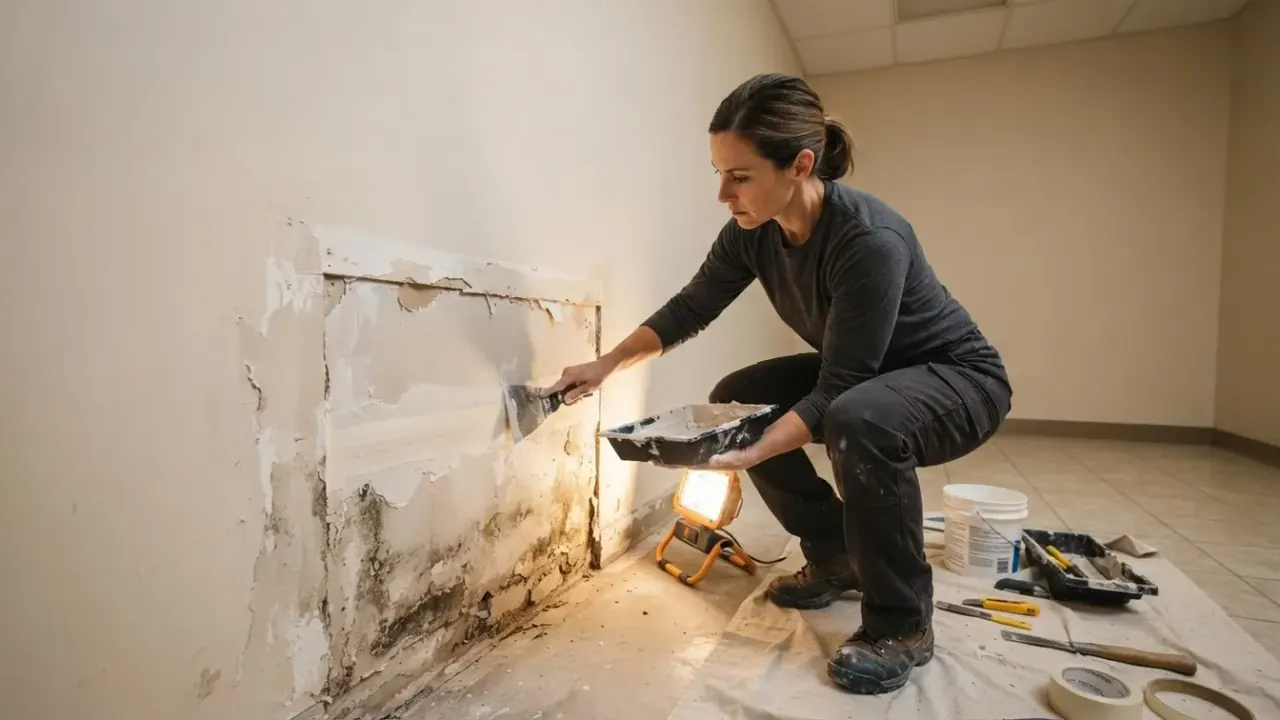
Your drywall is bubbling and peeling because water got behind the paint film, soaked into the paper face and gypsum core, and broke the bond that holds the finish to the board. The paint lifts into blisters, the paper face separates in sheets, and no amount of spackle over the top will hold until the moisture source is stopped and the wall is dried out. This post explains exactly why bubbling and peeling happen after water damage in Rockwall, how to tell whether the wall is still wet, what the repair actually involves, and when it makes more sense to call us than to keep patching.
Why bubbling and peeling shows up after water damage
Drywall bubbling and peeling after water damage in Rockwall TX is a moisture problem, not a paint problem. The paper facing on standard half-inch gypsum board is hygroscopic, which means it pulls water vapor out of the air and out of the wall cavity. When that paper gets wet, it swells, then shrinks as it dries, and the latex paint sitting on top cannot stretch with it. The paint film releases from the paper and forms a bubble. Once the paper fibers themselves start to delaminate, you get peeling sheets instead of blisters.
Water also carries dissolved salts and minerals from the gypsum core up to the surface. As the wall dries, those salts crystallize just under the paint and push it off from behind. That is why a wall that looked fine the day of the leak can look ruined a week later.
Why is my drywall bubbling after water damage in Rockwall?
In Rockwall, the three sources we see behind bubbling drywall more than any others are roof and flashing leaks, slow supply-line drips under sinks, and condensate from HVAC units in the attic. Rockwall sits on heavy black clay soil that swells when it is wet and shrinks hard when it dries. That movement works on plumbing joints and slab penetrations year after year, and a pinhole leak in a copper line can run inside a wall for weeks before you ever see a bubble.
Our summers make it worse. From June through September, attic temperatures in this part of North Texas routinely hit 140 degrees Fahrenheit, and an air handler sweating in that heat drips into the ceiling assembly below it. By the time the stain or bubble shows on your ceiling, the paper face has usually been wet for days. If you have already had one leak repaired and a new bubble shows up nearby, that is a strong sign the first repair did not address the full extent of the moisture.
We handle a lot of this work across water damaged drywall repair in Downtown Rockwall, where a mix of older homes and renovated commercial spaces means plumbing that has been added to and rerouted more than once.
Why does drywall peel instead of just staining?
Staining and peeling are two different stages of the same event. A stain means water reached the surface and dried without lifting the paint. Peeling means the water sat long enough to break down the paper-to-paint bond and, in bad cases, the paper-to-core bond underneath it. The longer the moisture stays, the deeper the damage goes.
Humidity matters here too. Rockwall averages around 65 percent relative humidity in the spring and fall, and that ambient moisture slows drying inside a wall cavity dramatically. A wall that would dry in three days in a dry climate can take a week or more here if it is not actively dried with air movers and a dehumidifier.
How to tell if the moisture is still active
Before you spend a dollar on patching, find out whether the wall is still wet. A pin-type moisture meter reads the percentage of moisture in the board, and anything above 15 percent means the drywall is still holding water. You can also press a paper towel against the wall and hold it for 30 seconds. If it comes away damp, the moisture is active.
Other signs the source is still running:
- The bubble feels soft or spongy when you press it.
- Paint flakes off with almost no pressure.
- You smell a musty, earthy odor in the room.
- The drywall is cool to the touch compared to surrounding walls.
- A water bill jumped without a change in usage.
If any of those are true, stop. Patching now just traps moisture and gives mold a food source. We run a full drywall water damage assessment rockwall TX before we quote any repair, because the fix depends entirely on what the meter says.
How to fix bubbling drywall from water damage in Rockwall TX
The repair sequence is always the same: stop the water, dry the assembly, then rebuild the finish. Skipping step two is the single most common reason a repair fails six months later.
- Stop the source. Fix the leak, replace the failed fitting, or clear the condensate line. Nothing else matters until this is done.
- Dry the wall. We set air movers and a commercial dehumidifier and run them until the board reads under 12 percent moisture. In Rockwall's humidity, that is usually 2 to 4 days.
- Cut out what will not dry. Blistered paper and crumbled gypsum do not come back. We remove the damaged section back to sound board.
- Treat for mold if needed. Any wall that stayed wet more than 48 hours gets treated. We handle that with mold remediation water damaged drywall rockwall TX before new board goes up.
- Replace and finish. New drywall, tape, three coats of joint compound, sand, prime, and paint to match.
If the damage is limited to the surface and the board is structurally sound, we can often seal and refinish instead of replacing. That is a good option for a wall that got damp but never soaked. For anything deeper, water damaged drywall replacement rockwall TX is the honest answer.
Common mistakes we see homeowners make
The most expensive mistake is painting over a bubble without checking moisture. The paint looks fine for a month, then the bubble comes back bigger because the trapped water had nowhere to go.
Other repeat offenders:
- Using spackle on a wet wall. Joint compound will not bond to damp paper. It pops off in a sheet.
- Running a household fan and calling it dried. A box fan moves air but does not pull water out of the cavity. You need a dehumidifier.
- Ignoring the ceiling above a wall bubble. Water travels down and sideways. If the wall is bubbling, check the ceiling and the floor above.
- Waiting to see if it gets worse. Mold can colonize a wet wall in 24 to 48 hours. Waiting costs more than fixing.
When to call a professional
Call us when the bubble covers more than a square foot, when the wall reads wet on a meter, when you can smell mold, or when you cannot find the source of the leak. Those are the four situations where a DIY patch turns into a repeat repair.
Drywall Masters handles the whole job: we find the moisture, dry the assembly, replace what is ruined, and finish the wall so it disappears. We work all over the Rockwall area, including lakefront neighborhoods where wind-driven rain and older plumbing keep us busy. Homeowners near the water deal with this constantly, and we do a steady volume of water damaged drywall repair in The Harbor for exactly that reason.
Typical 2026 pricing in this area runs $250 to $600 for a small patch and refinish, and $900 to $2,500 for a full wall or ceiling replacement with drying. We give you the number before we start.
Frequently Asked Questions
Why is my drywall bubbling after water damage in Rockwall?
Water gets behind the paint film and soaks the paper facing, which swells and breaks the paint bond. In Rockwall, clay soil movement and high summer attic heat make slow supply-line and condensate leaks common, so bubbles often show up days after the leak starts.
Can bubbling drywall be repaired in Rockwall TX?
Yes, in most cases. If the board reads under 12 percent moisture after drying and the gypsum core is intact, we seal and refinish it. If the paper face has delaminated or the core is crumbled, we cut out and replace that section. Either way, the repair lasts once the wall is dry.
Who fixes peeling drywall near me in Rockwall?
Drywall Masters repairs peeling and bubbling drywall throughout Rockwall, from Downtown to The Harbor and the lakefront neighborhoods. We stop the moisture, dry the wall, and finish it to match. Call 972-884-4781 and we will take a look.
Does bubbling drywall mean water damage in Rockwall Texas?
Almost always, yes. A bubble means moisture reached the back of the paint film. It can come from a roof leak, a plumbing drip, or HVAC condensate. Occasionally high indoor humidity alone causes it, but that is rare here. A moisture meter settles it in about 30 seconds.
How much does drywall bubbling repair cost in Rockwall TX?
In 2026, expect $250 to $600 for a small patch and refinish, and $900 to $2,500 for a full wall or ceiling replacement including drying. Cost climbs with square footage, whether mold treatment is needed, and how hard the leak is to reach.
Get help with water damaged drywall repair in Rockwall
If your drywall is bubbling or peeling, the fix starts with finding the moisture and ends with a wall you cannot tell was ever damaged. We do both, and we do it across Rockwall.
Call Drywall Masters at 972-884-4781 and we will get a moisture reading, a straight answer, and a price before any work begins.